
Artificial Intelligence (AI) is moving beyond traditional conversational chatbots towards more capable AI agents. Businesses are increasingly adopting Enterprise AI Agent Architecture to build intelligent systems that can understand business objectives, reason about problems, make decisions, interact with enterprise applications, execute tasks, and improve operational effectiveness.
Traditional chatbots are primarily designed to answer predefined questions and guide users through conversations. AI agents go a step further by combining reasoning, enterprise knowledge, integration capabilities and controlled execution to complete business tasks.
Consider a simple business scenario.
A customer contacts a travel company to change a flight booking. A traditional chatbot might explain the cancellation policy or direct the customer to a support representative.
An AI agent, on the other hand, could:
- Understand the customer’s request and identify the relevant booking.
- Retrieve booking details and applicable business policies.
- Evaluate available flight alternatives.
- Determine whether the requested change is permitted.
- Calculate applicable charges using enterprise pricing services.
- Execute the approved change through enterprise APIs.
- Update the booking and notify the customer.
- Verify whether the requested change was completed successfully.
This represents a significant shift from conversational automation to intelligent business process execution. However, building such an agent requires more than selecting a Large Language Model (LLM) and writing a good prompt.
It requires a well-designed AI agent architecture that brings together AI intelligence, enterprise data, reasoning, memory, integration, execution, security, monitoring and governance.
As enterprise architects, we need to think about AI agents as engineered enterprise systems rather than isolated AI components. The objective is not simply to build an agent that can respond intelligently, but one that can operate reliably, securely and responsibly within existing business processes and enterprise applications.
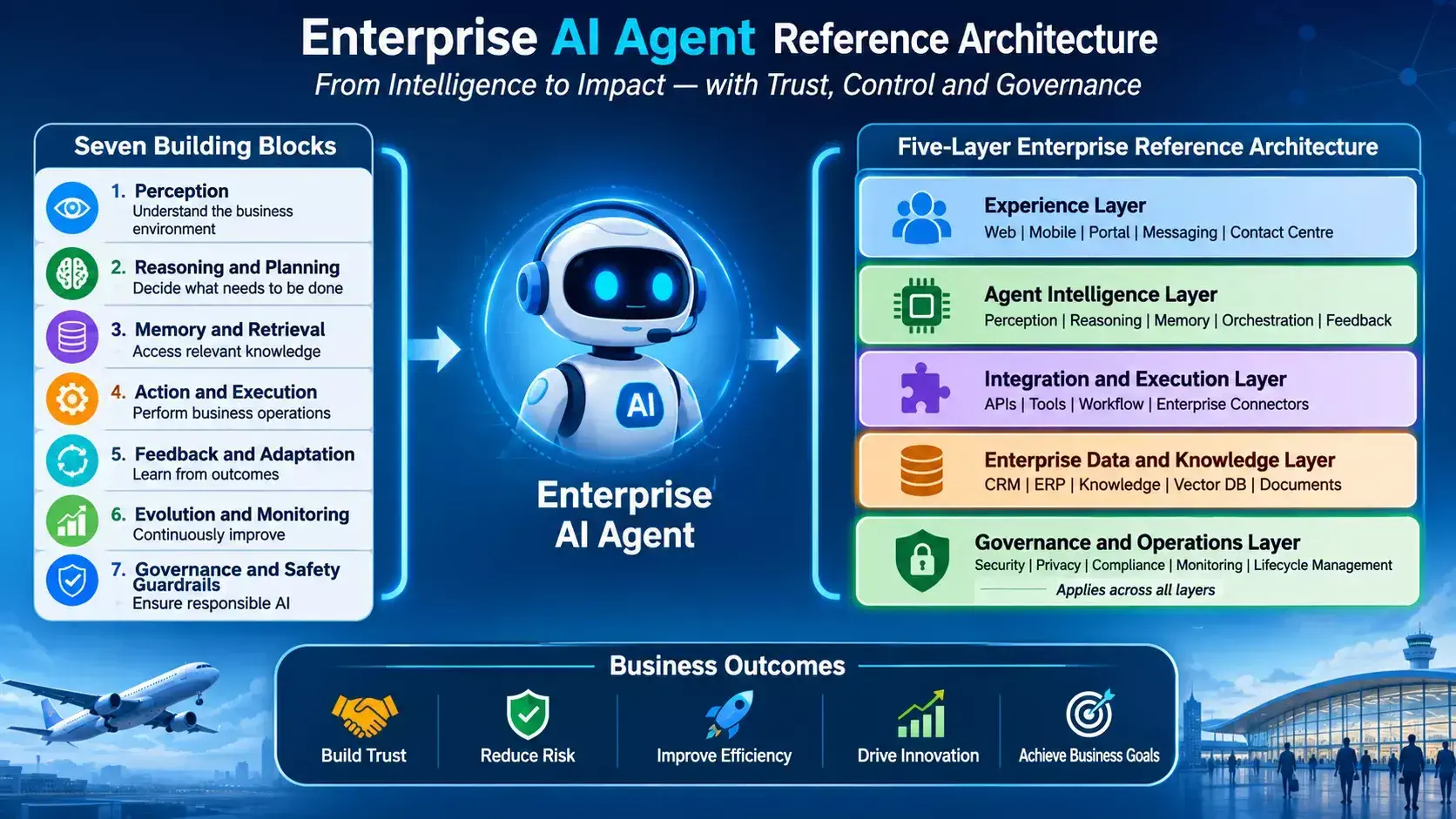
In this article, we will explore the seven core building blocks of Enterprise AI Agent Architecture and understand how they come together to create scalable, secure and business-ready AI agents.
- 1. Perception – Understanding the Business Environment
- 2. Reasoning and Planning – Deciding What Needs to Be Done
- 3. Memory and Retrieval – Giving Agents Access to Knowledge
- 4. Action and Execution – Turning Decisions into Business Outcomes
- 5. Feedback and Adaptation – Learning from Outcomes
- 6. Evolution and Monitoring – Managing the Agent Lifecycle
- 7. Governance and Safety Guardrails – Building Trust into AI
- An Enterprise AI Agent Reference Architecture
- What Should Business Owners Consider Before Investing in AI Agents?
- Summary
- Related Posts
1. Perception – Understanding the Business Environment
Perception is the agent’s ability to understand incoming information, identify what is being requested, and interpret the surrounding business context.
Before an AI agent can make decisions or execute tasks, it must understand what is happening, who is making the request, and what information is relevant.
In an enterprise environment, information can arrive through multiple channels and in different formats. The agent must be capable of processing this information and converting it into meaningful business context.
What does perception involve?
1. Input Collection – Receiving information from different channels
The agent must be able to receive information from multiple sources, including customer conversations, emails, uploaded documents, application events, and API requests.
Example: A customer sends a message through a website asking to change a flight booking.
2. Input Processing – Preparing information for understanding
Incoming information may be unstructured, incomplete, or available in different formats. The system processes and prepares it so the agent can interpret it.
Example: Extracting readable text from an uploaded PDF ticket or converting an audio request into text.
3. Intent Identification – Understanding what the user wants
The agent identifies the actual purpose behind a request rather than simply matching individual words.
Example: Identifying whether the customer wants to modify a booking, cancel a ticket, request a refund, or check booking status.
4. Entity Extraction – Identifying important business information
The agent identifies relevant details from the request that are required to understand or perform the task.
Example: Extracting booking reference, passenger name, travel date, flight number, and requested destination.
5. Context Enrichment – Understanding the surrounding business situation
The agent retrieves additional information from enterprise applications to understand the request in its business context.
Example: Checking the customer’s booking status, passenger details, current itinerary, and applicable business policies.
6. Multimodal Understanding – Interpreting different types of information
When required, the agent should be capable of understanding information beyond text, including images, audio and documents.
Example: A customer uploads a screenshot of a flight ticket instead of typing the booking details.
How do these capabilities work together?
Consider a customer requesting a change to their return flight. The perception layer processes the request through the following steps:
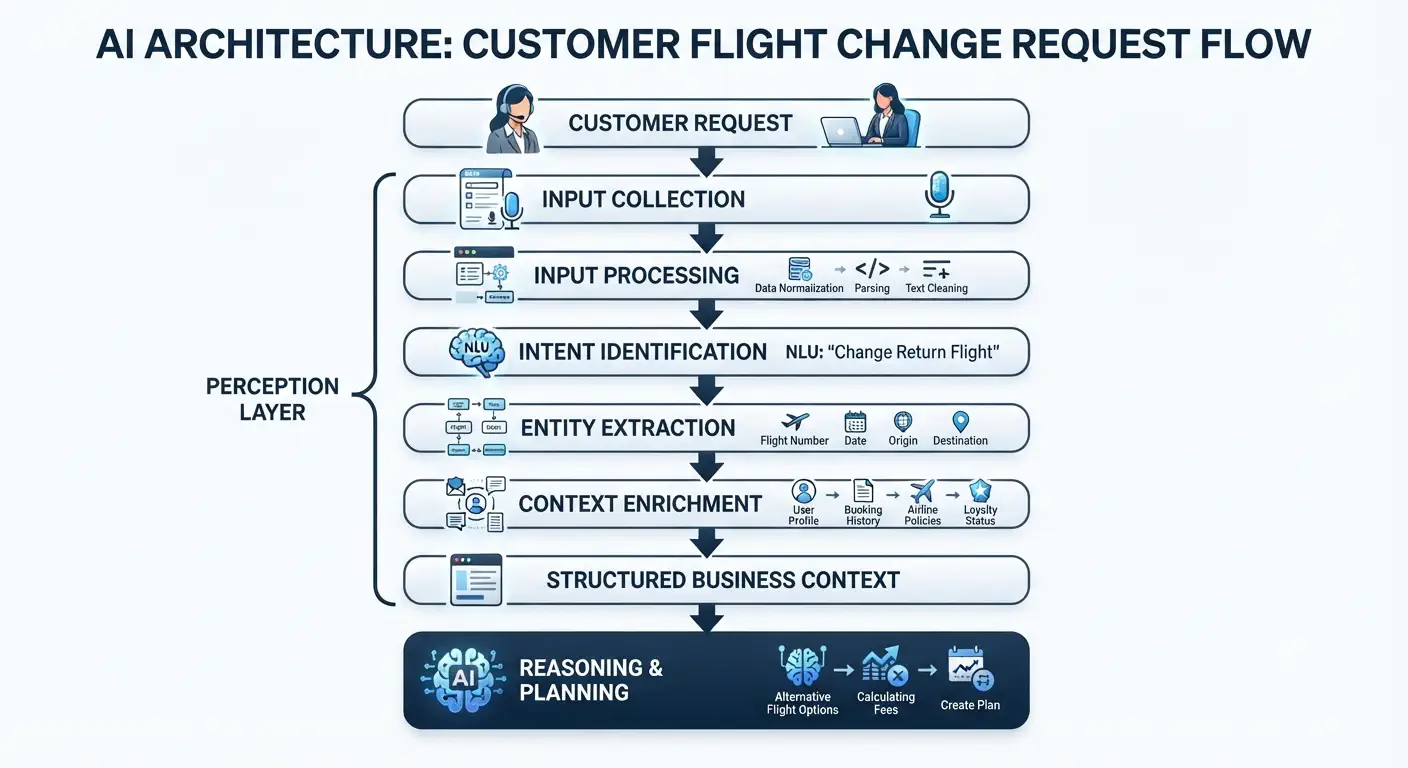
At the end of this process, the agent will understand:
- What the customer wants: Modify a return flight.
- Which booking is involved: The relevant booking reference.
- What change is requested: Move the return flight to Monday.
- What additional information is available: Passenger details, current itinerary and booking status.
- What information is still missing: Any details required before the agent can proceed.
The resulting business context becomes the input for the next building block: Reasoning and Planning.
Key Architectural Considerations
From an enterprise architecture perspective, perception requires careful consideration of several areas:
- Input channel integration: Support different customer channels, enterprise applications and event sources.
- Data validation: Validate important business information such as booking references, customer identifiers and dates against authoritative systems.
- Context accuracy: Ensure the agent uses current and relevant business information rather than relying only on the conversation.
- Identity and security: Establish who is making the request before exposing sensitive customer or business information.
- Error handling: Identify incomplete, ambiguous or conflicting information and ask for clarification when necessary.
- Multimodal support: Introduce image, audio and document processing based on actual business requirements.
Business Value
An effective perception layer helps businesses reduce misunderstandings, improve request classification, minimize unnecessary customer interactions and provide agents with the right context before decisions are made.
2. Reasoning and Planning – Deciding What Needs to Be Done
Once an AI agent understands the user’s request and has the relevant business context, the next step is to determine what needs to be done.
This is where reasoning and planning come into play.
Reasoning enables an agent to evaluate information, understand business objectives, consider available options and make decisions. Planning converts those decisions into a structured sequence of tasks that can be executed.
For enterprise AI agents, this is one of the most important capabilities because business processes often involve multiple decisions, dependencies, business rules and approval requirements.
What does reasoning and planning involve?
1. Objective Understanding – Identifying the desired business outcome
The agent must understand what the user or business process is trying to achieve. It should distinguish between the requested action and the actual business outcome.
Example: A customer requests a return flight change. The desired outcome is to modify the existing booking to a suitable alternative flight while preserving the rest of the itinerary.
2. Information Evaluation – Assessing available business context
Before making a decision, the agent evaluates the information received from the perception layer and identifies whether it has enough information to proceed. It considers relevant customer records, transaction details, business policies, available options, and operational constraints.
Example: Checking whether the booking is confirmed, whether the passenger is eligible for a flight change, and whether the requested travel date is available.
3. Decision-Making – Evaluating available options
The agent evaluates possible actions and determines which options are appropriate based on business objectives, available information, and predefined policies. Some decisions can be handled by the AI model, while others should be determined by business rules or dedicated decision services.
Example: Determining whether the customer can change the flight without a penalty, needs to pay a fare difference or requires manual assistance.
4. Task Decomposition – Breaking down complex objectives
Complex business objectives should be divided into smaller, manageable tasks. This allows the agent to handle each activity independently while maintaining the overall business objective.
Example: A flight modification may require retrieving available flights, checking fare differences, validating eligibility, obtaining customer confirmation, and updating the booking.
5. Dependency Management – Understanding the sequence of activities
Not every task can be executed independently. Some activities depend on the successful completion of previous tasks. The agent must understand these dependencies and determine the appropriate execution sequence.
Example: The booking should be validated before searching for modification options. The customer must confirm the selected alternative before the booking is modified.
6. Plan Validation – Ensuring the proposed actions are appropriate
Before execution, the proposed plan should be validated against business rules, authorization policies, operational constraints and approval requirements.
High-impact decisions may require human approval before the agent can proceed.
Example: A flight change involving a significant additional payment may require explicit customer confirmation before the transaction is submitted.
Key Architectural Capabilities and Responsibilities
Several architectural capabilities work together to support reasoning and planning.
Reasoning and decision services: Evaluate business context, available information and possible actions to determine an appropriate course of action.
Planning and orchestration: Convert business objectives into structured tasks and coordinate their execution.
Business rules and policy engine: Apply deterministic business rules, eligibility conditions, transaction limits and operational policies.
Task and state management: Maintain the current task status, completed activities, pending actions and execution dependencies.
Approval and escalation management: Identify decisions that require human intervention, additional information or authorization.
Planning context management: Ensure the agent retains the objective and relevant information while moving between different tasks.
How do these capabilities work together?
Consider the same customer requesting a return flight change. The perception layer has already identified the request and retrieved the relevant booking information.
The reasoning and planning layer now determines how to fulfil the request.
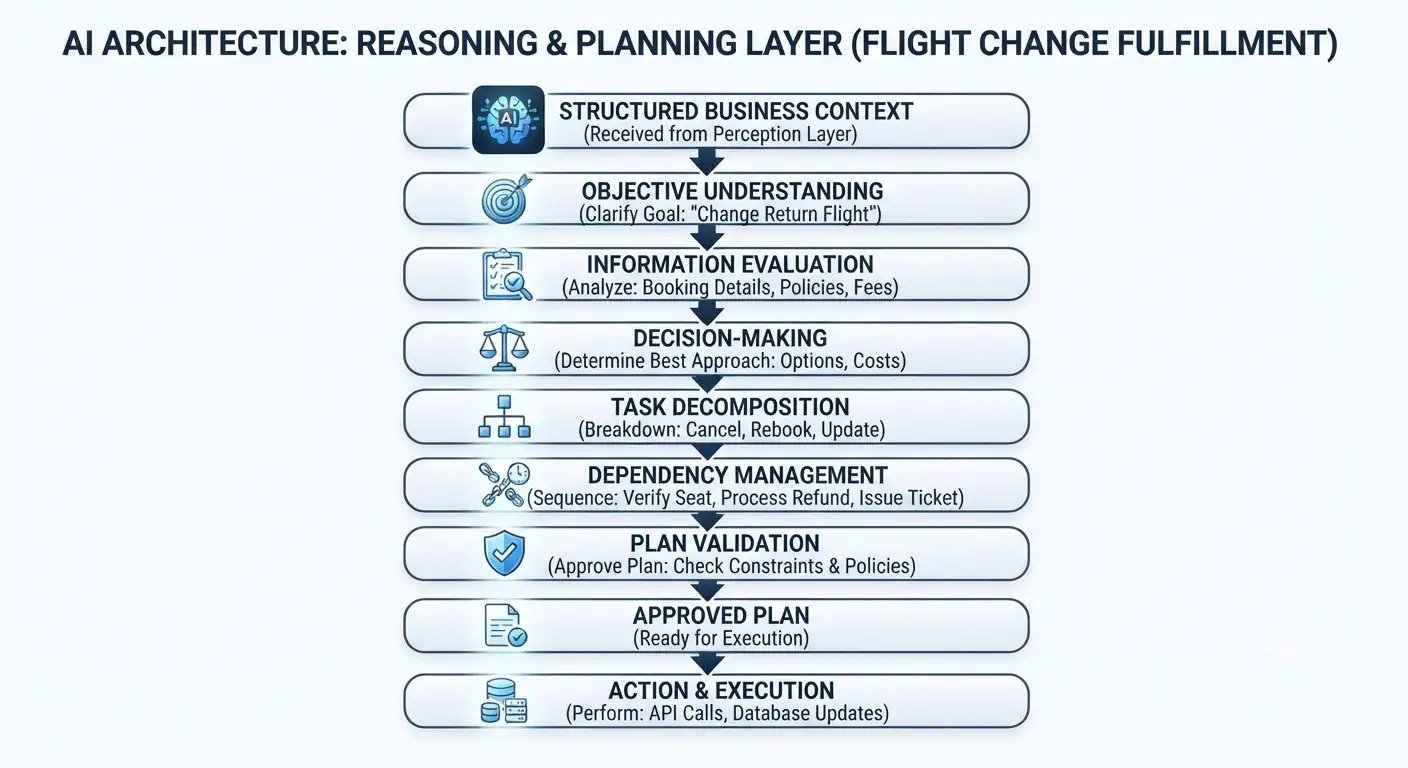
The agent may generate the following execution plan:
| Sequence | Task | Expected outcome |
|---|---|---|
| 1 | Validate booking eligibility | Confirm that modification is permitted |
| 2 | Retrieve alternative flights | Identify available flights |
| 3 | Evaluate fare differences | Calculate additional charges or refunds |
| 4 | Present alternatives | Allow the customer to select an option |
| 5 | Obtain confirmation | Capture customer approval |
| 6 | Modify the booking | Submit the approved change |
| 7 | Verify the result | Confirm the updated itinerary |
The plan may change depending on the information available, business rules or execution results.
For example, if no suitable flight is available, the agent may need to revise its plan, offer another date or escalate the request to a human representative.
Key Architectural Considerations
From an enterprise architecture perspective, reasoning and planning require careful consideration of the following:
- Decision boundaries: Clearly define which decisions the AI agent can make independently and which must be handled by deterministic business rules or human approval.
- Business rule enforcement: Do not depend exclusively on LLM-generated reasoning for critical eligibility, financial or compliance decisions.
- Planning reliability: Ensure generated plans follow defined business processes and do not skip mandatory activities.
- Task dependencies: Manage execution order, prerequisites and parallel activities where appropriate.
- State management: Maintain task progress and context across multiple execution steps, including interruptions and failures.
- Human oversight: Define when the agent must request confirmation, seek approval or escalate a task.
- Execution constraints: Restrict the agent to approved tools, actions and business operations.
Business Value
Effective reasoning and planning enable organizations to automate complex business processes rather than simply answering questions.
They help reduce manual decision-making, improve process consistency, coordinate multiple activities and accelerate business operations.
3. Memory and Retrieval – Giving Agents Access to Knowledge
An AI agent needs more than the ability to understand requests and make decisions. It also needs access to relevant information and the ability to retain context across interactions and tasks.
This is where memory and retrieval come into play.
Memory allows an agent to retain relevant information from ongoing or previous interactions. Retrieval enables it to access information from enterprise systems, databases, documents and knowledge repositories whenever required.
Together, these capabilities help agents make informed decisions using both historical context and current business information.
For enterprise AI agents, this is particularly important because business decisions often depend on customer history, previous transactions, organizational knowledge and up-to-date operational information.
What do memory and retrieval involve?
1. Working Memory – Maintaining context during an active task
An agent needs to remember information gathered during an ongoing conversation or business process. This prevents it from repeatedly asking for the same information and helps it maintain continuity throughout a task.
Example: A customer is exploring alternative flights. The agent remembers the selected travel date, preferred departure time and flight options already discussed during the conversation.
2. Long-Term Memory – Retaining relevant information across interactions
Some information may be useful beyond a single conversation. Long-term memory allows an agent to retain relevant information for future interactions, subject to business requirements, user consent and data retention policies.
Example: A customer has previously expressed a preference for aisle seats. The agent may use this preference when assisting with a future booking, if the information is retained and authorized for that purpose.
3. Episodic Memory – Remembering Previous Interactions and Outcomes
Episodic memory captures information about previous interactions, tasks performed, decisions made and their outcomes.
This helps agents understand historical context and avoid repeating unsuccessful approaches.
Example: The agent can refer to a previous booking modification request, including the alternative flight offered and the customer’s decision.
4. Semantic Memory – Retaining Business Knowledge and Relationships
Semantic memory represents knowledge about business concepts, terminology, policies and relationships between different entities.
It helps an agent understand how business information is connected rather than treating every piece of information independently.
Example: Understanding the relationship between customers, bookings, passengers, flights, travel packages and cancellation policies.
5. Enterprise Knowledge Retrieval – Accessing Business Information When Required
An agent frequently needs information that is not already available in its conversation or memory.
Retrieval capabilities allow it to search enterprise knowledge sources such as CRM records, ERP systems, knowledge bases, policy documents, product catalogues and operational databases.
Example: Retrieving the latest flight modification policy, current booking information and applicable fare conditions before recommending an alternative.
6. Retrieval-Augmented Generation (RAG) – Grounding Responses in Enterprise Knowledge
RAG is an architectural approach that allows an agent to retrieve relevant information from enterprise knowledge sources and provide that information as context to an LLM.
Instead of relying entirely on information learned during model training, the agent can use relevant and up-to-date enterprise knowledge when generating responses.
A typical RAG process involves:
- Preparing and indexing enterprise documents.
- Converting document content into searchable representations.
- Retrieving relevant information based on a user query.
- Ranking and filtering the retrieved results.
- Providing relevant context to the LLM.
- Generating a response grounded in the retrieved information.
Example: When a customer asks about cancellation charges, the agent retrieves the applicable cancellation policy and booking conditions before explaining the charges.
Key Architectural Capabilities and Responsibilities
Several architectural capabilities work together to support memory and retrieval.
Conversation and context management: Maintains the information exchanged during an active conversation or task, including previous questions, responses and pending activities.
Memory storage and management: Stores relevant historical information and interaction outcomes, with appropriate controls for retention, expiration and deletion.
Enterprise data connectivity: Connects agents to authoritative business systems such as CRM, ERP, booking platforms and operational databases.
Knowledge ingestion and indexing: Collects information from documents, knowledge repositories and other sources, then prepares it for efficient search and retrieval.
Search and retrieval services: Identify relevant information using keyword search, semantic search, metadata filtering or a combination of these approaches.
Embedding and vector search: Convert content into numerical representations that support semantic similarity searches across large knowledge collections.
Context assembly and grounding: Selects and organizes retrieved information so the LLM receives relevant, trustworthy context before generating a response.
Data access and authorization: Ensures that retrieved information respects user permissions, data classification, privacy and enterprise security policies.
How do these capabilities work together?
Consider a customer asking about changing a return flight. The perception layer has identified the request, and the reasoning layer is preparing the next steps.
Before making a recommendation, the agent needs access to several types of information:
- Current booking and passenger details.
- Applicable flight modification policies.
- Available flight options.
- Previous customer preferences.
- Relevant interaction history.
Memory and retrieval provide this information. The agent now has the relevant information required to evaluate the customer’s request.
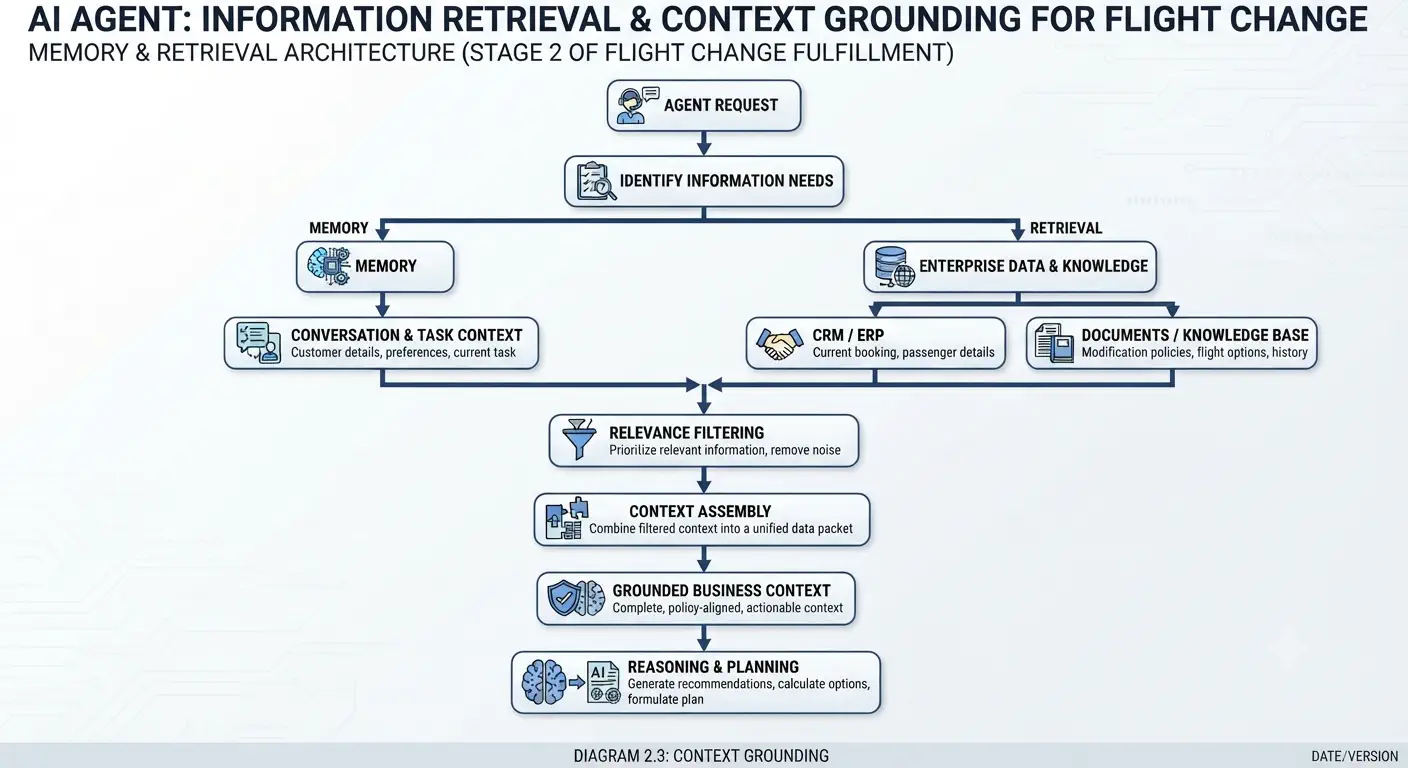
For example, it can use the customer’s current booking details, applicable modification policy and previous preferences to evaluate suitable alternatives.
Key Architectural Considerations
From an enterprise architecture perspective, memory and retrieval require careful consideration of the following:
- Memory selection: Decide what information needs to be retained, for how long and for what business purpose. Not every conversation or customer interaction should become long-term memory.
- Data freshness: Ensure agents retrieve current information from authoritative systems, particularly for pricing, availability, policies and transaction status.
- Knowledge quality: Establish processes for document ingestion, duplicate detection, version management and removal of outdated information.
- Retrieval accuracy: Evaluate whether the retrieved information is relevant, complete and sufficient to answer the user’s request.
- Security and permissions: Apply access controls during retrieval rather than relying only on the LLM to avoid disclosing sensitive information.
- Memory isolation: Ensure information belonging to one customer, user or business process is not exposed to another.
- Context management: Avoid sending excessive or irrelevant information to the LLM. Select only the context needed for the current task.
- Privacy and retention: Define encryption, consent, retention, deletion and audit requirements for stored information.
Business Value
Effective memory and retrieval help organizations build AI agents that understand customer history, access enterprise knowledge and provide more relevant and consistent responses.
They reduce repeated information gathering, improve decision quality, make organizational knowledge more accessible and enable agents to support complex business processes.
4. Action and Execution – Turning Decisions into Business Outcomes
An AI agent becomes operationally valuable when it can do more than understand requests, retrieve information and recommend solutions. It must also be capable of performing actions in enterprise applications and business systems.
This is where Action and Execution come into play.
Action represents the ability of an agent to invoke tools, services and business capabilities to accomplish a task. Execution manages how those actions are validated, authorized, performed and verified.
For enterprise AI agents, this is particularly important because business operations often involve multiple applications, APIs, transactions, workflows and approval mechanisms.
An agent may identify that a customer’s flight needs to be changed, but completing that request requires interaction with booking systems, payment services, customer records and notification platforms.
What do action and execution involve?
1. Tool Selection – Identifying the right capability for an action
An agent needs access to a set of predefined tools and business capabilities. Based on the execution plan, it selects the appropriate tool to perform the next task.
These tools may provide capabilities such as retrieving records, checking availability, calculating charges, updating information or initiating business workflows.
Example: Selecting a booking search tool to retrieve alternative flights for a customer’s existing reservation.
2. Tool and API Invocation – Communicating with Enterprise Systems
Once the appropriate tool is selected, the agent invokes it through a defined interface.
This may involve calling REST APIs, enterprise application services, predefined functions or automation workflows.
Example: Calling a flight availability API to retrieve alternative flights for the requested travel date.
3. Authorization and Validation – Ensuring the Action Is Permitted
Before executing an action, the system must validate whether the requesting user or agent has permission to perform it.
It must also verify that the required information is available and that the action complies with applicable business rules.
Example: Verifying booking ownership, checking modification eligibility and validating that the selected flight can be booked.
4. Workflow Orchestration – Coordinating Multiple Business Activities
Many enterprise operations require multiple activities across different systems.
Workflow orchestration coordinates these activities, manages dependencies and ensures that tasks are performed in the correct sequence.
Example: A flight modification may require validating the booking, retrieving available flights, calculating fare differences, obtaining customer confirmation and submitting the modification.
5. Transaction Execution – Performing the Actual Business Operation
After all required validations and approvals, the execution layer performs the requested business operation in the relevant enterprise system.
Depending on the business process, this may involve creating records, updating transactions, initiating payments or triggering workflows.
Example: Submitting the approved flight modification request to the reservation system and updating the corresponding booking information.
6. Result Verification – Confirming That the Action Was Successful
An agent should never assume that an action succeeded simply because an API request was submitted.
The system must evaluate the response, verify the resulting business state and identify any errors or incomplete operations.
Example: Confirming that the airline reservation system has returned a successful modification response and that the updated itinerary reflects the customer’s selected flight.
7. Error Handling and Recovery – Managing Execution Failures
Enterprise systems can experience API timeouts, service interruptions, validation failures and partial transaction completion.
The execution layer must handle these situations through appropriate retry mechanisms, error handling, compensating actions or human escalation.
Example: If a flight modification request fails because the selected flight is no longer available, the agent can retrieve alternative options and ask the customer to make another selection.
Key Architectural Capabilities and Responsibilities
Several architectural capabilities work together to support action and execution.
Tool and function registry: Maintains the approved tools and business capabilities available to the agent, including their descriptions, input parameters and expected outputs.
API and service integration: Provides secure connectivity to CRM, ERP, payment platforms, booking systems and other enterprise applications.
Authorization and policy enforcement: Validates user identity, agent permissions, data access and business policies before allowing an action.
Execution orchestration: Coordinates multiple actions, manages task dependencies and controls the sequence of business operations.
Transaction management: Handles transaction boundaries, duplicate prevention, idempotency and recovery mechanisms where required.
Workflow automation: Executes predefined business processes using workflow engines, automation platforms and enterprise application services.
Result validation: Checks execution responses and verifies whether the intended business outcome has actually occurred.
Error handling and recovery: Manages failures, retries, compensating transactions and escalation to human operators.
How do these capabilities work together?
Consider the customer who requested a change to their return flight.
The reasoning and planning layer has already evaluated the request and prepared an execution plan. The action and execution layer now carries out the approved activities.
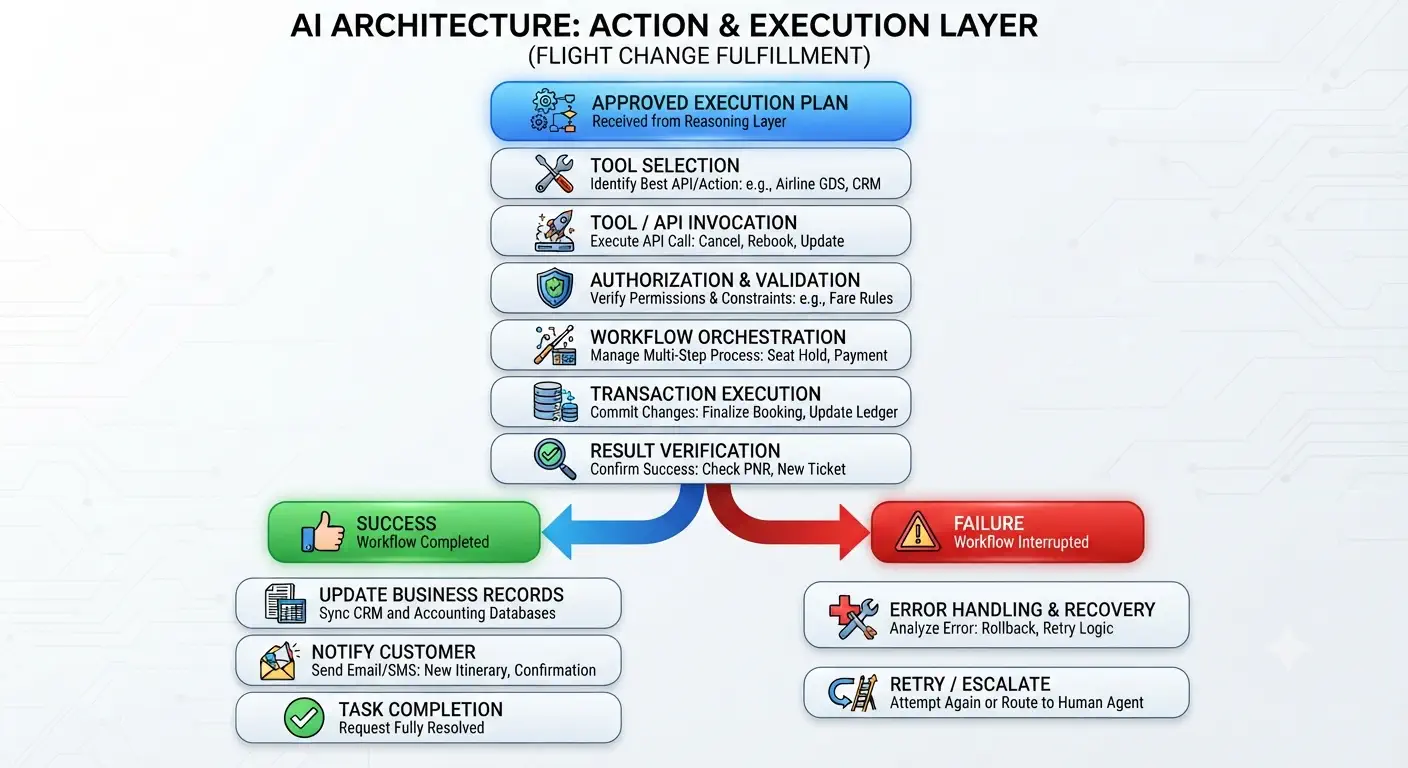
The actual execution may involve several enterprise systems.
For example:
| Sequence | Action | Enterprise system |
|---|---|---|
| 1 | Retrieve current booking | CRM / Booking System |
| 2 | Check alternative flights | Airline API |
| 3 | Calculate fare difference | Pricing Service |
| 4 | Capture customer confirmation | Customer Portal |
| 5 | Submit modification | Reservation System |
| 6 | Update booking information | CRM |
| 7 | Send confirmation | Email / Notification Service |
The agent coordinates these activities through approved tools and integrations.
The execution layer must also account for situations where one system completes its operation but another system fails. Such scenarios require appropriate recovery and reconciliation mechanisms.
Key Architectural Considerations
From an enterprise architecture perspective, action and execution require careful consideration of the following:
- Least-privilege access: Give agents access only to the tools, records and operations required for their assigned responsibilities.
- API security: Secure all interactions using appropriate authentication, authorization, encryption and credential management.
- Idempotency: Ensure that retrying an operation does not accidentally create duplicate bookings, payments or transactions.
- Transaction integrity: Design multi-system operations with appropriate transaction boundaries, compensating actions and reconciliation processes.
- Execution boundaries: Clearly define which actions the agent can perform autonomously and which require explicit user confirmation or human approval.
- Error handling: Account for timeouts, service failures, invalid responses, partial completion and unexpected business conditions.
- State management: Track the progress and outcome of each action so interrupted processes can resume or recover safely.
- Auditability: Maintain records of the requested action, invoking agent, user context, authorization decision, execution result and relevant timestamps.
- External system reliability: Design for rate limits, API availability, retry policies and service-level expectations.
Business Value
Effective action and execution capabilities allow organizations to move from AI-assisted recommendations to actual business process automation.
They reduce manual effort, eliminate repetitive activities, improve processing speed and enable end-to-end automation across enterprise applications.
5. Feedback and Adaptation – Learning from Outcomes
An AI agent should not simply execute an action and assume that the task has been completed successfully.
It must evaluate the outcome, understand whether the intended business objective has been achieved and determine whether any further action is required.
This is where Feedback and Adaptation come into play.
Feedback provides information about the results of an agent’s actions, decisions and interactions. Adaptation allows the agent to use that information to adjust its approach, revise its execution plan or escalate a problem when necessary.
For enterprise AI agents, this capability is particularly important because business processes rarely follow a perfect path. External systems may fail, business conditions may change, information may be incomplete and customers may change their requirements during an interaction.
An effective agent must be able to respond to these situations rather than simply following its original execution plan.
What do feedback and adaptation involve?
1. Outcome Evaluation – Determining Whether the Objective Was Achieved
After executing an action, the agent needs to evaluate whether the expected business outcome was achieved.
This requires comparing the actual result against the original objective and expected execution result.
Example: After submitting a flight modification request, the agent checks whether the reservation system confirms the updated flight details.
2. Execution Feedback – Understanding Results from Enterprise Systems
Enterprise applications and external services provide responses after an action is performed. These responses may indicate success, failure, warnings or additional requirements.
The agent must interpret these results to understand the current state of the process.
Example: The airline API returns a response indicating that the selected flight is no longer available. The agent identifies that the modification cannot proceed with the selected option.
3. Failure Analysis – Identifying Why an Action Did Not Succeed
When an operation fails, the agent should identify the nature of the failure rather than repeatedly attempting the same action.
Failures may occur because of invalid information, business rule violations, unavailable services, authorization issues or changing business conditions.
Example: A booking modification fails because the selected flight has reached its passenger capacity. The agent identifies that this is an availability issue rather than a technical failure.
4. Strategy Adjustment – Determining an Alternative Approach
Based on the feedback received, the agent may need to modify its approach to achieve the original business objective.
This could involve retrieving alternative information, selecting another approved tool, requesting missing details or changing the execution sequence.
Example: Since the selected flight is unavailable, the agent searches for alternative flights on the same date and presents suitable options to the customer.
5. Replanning and Retry – Continuing the Process Safely
When an action cannot be completed, the agent may revise its execution plan and continue with an alternative approach.
However, retries must follow predefined rules to avoid duplicate transactions, repeated failures or unintended business operations.
Example: If a temporary API timeout occurs, the execution layer checks the transaction status before retrying the booking modification request.
6. Human Feedback – Incorporating Human Decisions and Corrections
Not every situation can or should be resolved autonomously.
Agents should be able to collect feedback from human users, business operators and subject matter experts when decisions require additional judgment or approval.
Example: If the requested flight change involves an exceptional refund condition, the agent escalates the request to a customer service representative and uses the approved decision to continue the process.
7. Improvement Feedback – Capturing Information for Future Enhancements
Information collected from completed tasks, failures, human corrections and business outcomes can help organizations identify areas where agents need improvement.
This feedback can be used to refine prompts, update business rules, improve retrieval quality, enhance tools or redesign workflows through controlled development and testing processes.
Example: Monitoring reveals that the agent frequently recommends unavailable flights because of delayed availability data. The architecture team improves the data synchronization process and updates the agent’s evaluation tests.
Key Architectural Capabilities and Responsibilities
Several architectural capabilities work together to support feedback and adaptation.
Outcome evaluation: Compares actual execution results against the intended business objective and expected outcome.
Execution result processing: Interprets responses from APIs, tools, workflows and enterprise systems to determine the current process state.
Failure classification and diagnosis: Identifies whether failures are caused by technical issues, business constraints, invalid data, authorization problems or external dependencies.
Adaptive planning: Allows the agent to revise its plan based on new information, changing conditions or unsuccessful execution attempts.
Retry and recovery management: Controls retry attempts, prevents duplicate operations and coordinates recovery activities.
Human feedback and escalation: Collects human corrections, approvals and decisions when autonomous execution is inappropriate.
Evaluation and improvement pipeline: Captures performance information and converts recurring issues into controlled improvements to prompts, models, tools, knowledge and workflows.
How do these capabilities work together?
Consider the same customer requesting a return flight change.
The action and execution layer has submitted the modification request to the reservation system.
The feedback and adaptation layer now evaluates the result.
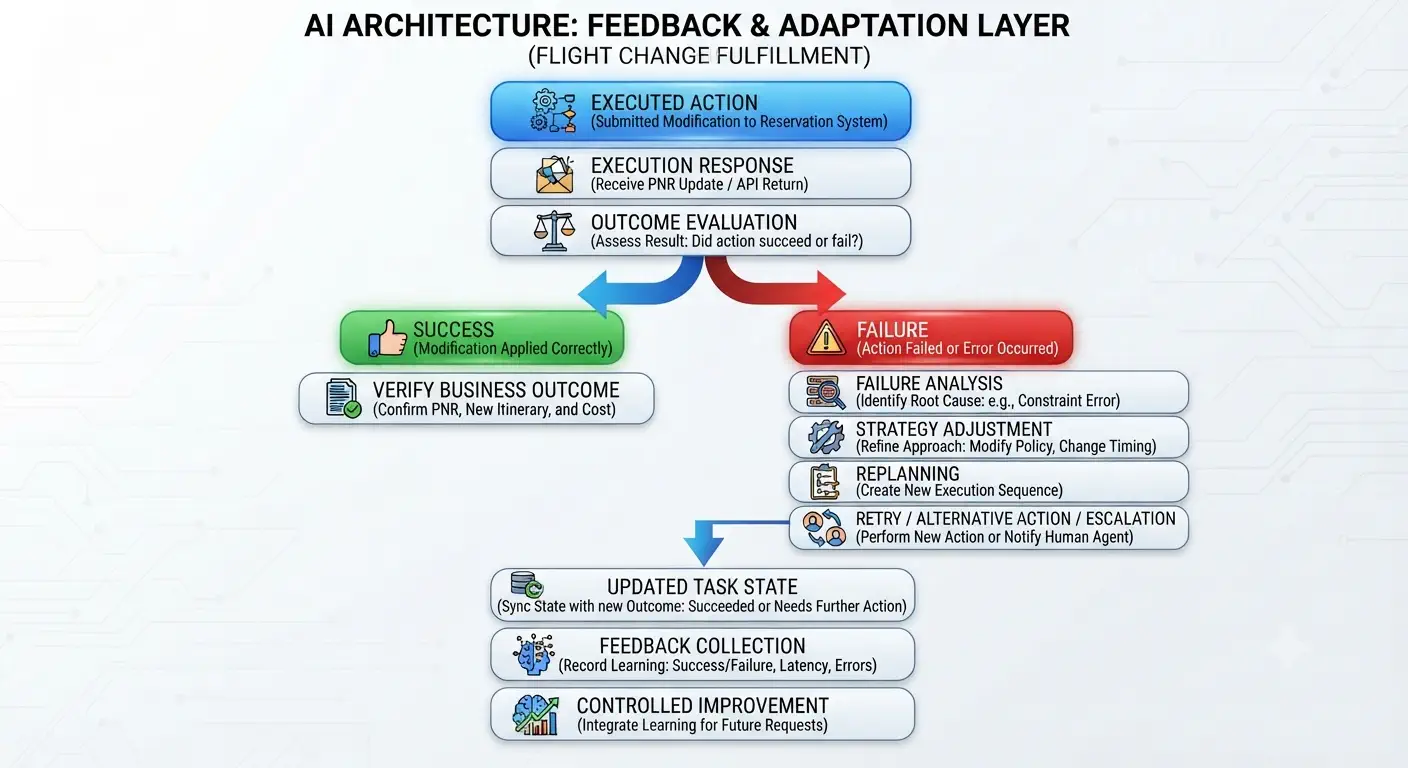
For example, consider three possible outcomes:
| Execution result | Agent response |
|---|---|
| Flight successfully modified | Verify the updated booking and notify the customer. |
| Selected flight unavailable | Retrieve alternatives and ask the customer to select another option. |
| Reservation API timeout | Check the transaction status before deciding whether to retry or escalate. |
This allows the agent to respond to actual business conditions instead of blindly following its original plan.
Key Architectural Considerations
From an enterprise architecture perspective, feedback and adaptation require careful consideration of the following:
- Outcome definition: Define measurable success criteria for every important business task. An API returning HTTP 200 does not always mean the business objective has been achieved.
- Failure classification: Distinguish between temporary technical failures, permanent business failures and situations requiring human intervention.
- Controlled retries: Apply retry limits, backoff strategies and idempotency controls to prevent duplicate or unintended transactions.
- State consistency: Maintain accurate task and transaction status across the agent and connected enterprise systems.
- Adaptation boundaries: Define which decisions the agent can adjust independently and which require business approval.
- Human feedback: Capture corrections and approvals in a structured manner so they can be evaluated and reused appropriately.
- Continuous evaluation: Use real-world execution results and test scenarios to identify weaknesses in agent behaviour.
- Controlled improvement: Validate changes to prompts, models, tools, knowledge and workflows before deploying them into production.
Business Value
Effective feedback and adaptation help organizations improve task completion rates, reduce repeated failures, handle unexpected situations and provide more reliable customer experiences.
They also create opportunities to identify process bottlenecks, improve automation quality and continuously enhance business operations.
6. Evolution and Monitoring – Managing the Agent Lifecycle
An AI agent is not a system that can be built once, deployed and left unchanged. Business processes evolve, enterprise data changes, APIs are updated, customer expectations shift, and new risks emerge. An agent that performs well today may become less reliable over time if it is not continuously monitored and maintained.
Evolution and Monitoring focuses on managing the agent throughout its lifecycle — from design and testing to deployment, production monitoring, evaluation and controlled improvement.
While Feedback and Adaptation focuses on handling the outcome of an individual task, Evolution and Monitoring looks at the overall health, reliability, performance and effectiveness of the agent across many interactions.
For example, consider a travel support agent that helps customers change flights. A single flight-change request may fail because the airline API is unavailable. Feedback and Adaptation handles that specific failure by retrying, selecting another approved approach or escalating the request.
However, if the airline API starts failing frequently, or the agent repeatedly selects unsuitable flight alternatives, the problem needs a broader investigation. Evolution and Monitoring identifies these recurring patterns and helps the architecture team improve the agent.
What Does Evolution and Monitoring Include?
An enterprise AI agent needs continuous oversight across its lifecycle. This includes monitoring its behaviour, measuring business outcomes, identifying problems, testing changes and managing new versions.
The main capabilities are:
- Agent Performance Monitoring – Track how the agent performs in production, including response time, task completion, failures and resource consumption.
- Quality and Accuracy Evaluation – Assess whether the agent understands requests correctly, retrieves relevant information, produces reliable responses and follows the intended process.
- Business Outcome Measurement – Measure whether the agent delivers meaningful business results, such as faster resolution, fewer manual interventions and improved customer experience.
- Behaviour and Risk Monitoring – Identify unexpected actions, policy violations, inappropriate responses, unusual tool usage and other risks.
- Root Cause Analysis – Investigate recurring failures and identify whether they originate from the model, prompts, enterprise data, retrieval, integrations, business rules or workflow design.
- Testing and Validation – Test changes against representative business scenarios before introducing them into production.
- Version and Release Management – Manage changes to models, prompts, tools, knowledge sources, policies and workflows through controlled releases.
- Continuous Improvement – Use monitoring and evaluation results to improve the agent in a controlled and measurable way.
Understanding the Key Capabilities
1. Agent Performance Monitoring
Once an agent is deployed, the enterprise needs visibility into how it behaves in real-world conditions.
Monitoring should cover both technical performance and operational behaviour.
For example, a travel support agent may receive thousands of customer requests. The operations team needs to understand:
- How many requests the agent receives.
- How quickly it responds.
- How many tasks it completes successfully.
- How often it fails or requires human assistance.
- Which tools and external services it uses.
- Whether response times or failure rates are increasing.
This information helps teams identify performance issues before they significantly affect customers.
Architectural responsibility: Establish monitoring and observability across the agent, its tools, integrations, models and supporting services. Capture meaningful events, execution traces, errors and performance metrics.
2. Quality and Accuracy Evaluation
A technically available agent is not necessarily a reliable agent. It may respond quickly but misunderstand customer requests, retrieve outdated information or recommend an incorrect action.
Quality evaluation checks whether the agent is producing the expected results.
For example, the travel agent may correctly identify that a customer wants to change a flight but retrieve an alternative that does not match the customer’s travel date or destination.
The evaluation process should examine:
- Whether the agent identified the correct customer intent.
- Whether it extracted the correct booking information.
- Whether it retrieved relevant and current policies.
- Whether its recommendations were grounded in reliable information.
- Whether its response followed the expected business process.
Evaluation can use predefined test scenarios, expected outcomes, automated checks and human review.
Architectural responsibility: Define evaluation criteria, maintain test scenarios and measure agent quality before and after changes. Use business-specific evaluation rather than relying only on generic language-model scores.
3. Business Outcome Measurement
Technical metrics alone cannot establish whether an AI agent is delivering business value.
An enterprise must measure whether the agent is helping achieve the original business objectives.
For example, a travel company may introduce an AI agent to reduce the workload of its customer support team.
The business should measure:
- Percentage of flight-change requests completed without human intervention.
- Average time required to resolve a request.
- Reduction in support team workload.
- Percentage of requests escalated to human agents.
- Customer satisfaction after agent interactions.
- Cost per successfully resolved request.
These measurements help business and technology leaders understand whether the investment is producing meaningful results.
Architectural responsibility: Connect agent performance data with business KPIs. Define measurable success criteria and ensure that the organization can distinguish genuine business outcomes from activity or usage metrics.
4. Behaviour and Risk Monitoring
AI agents can interact with sensitive business data and perform actions through enterprise applications. Their behaviour must therefore be monitored continuously.
For example, a travel agent should not access another customer’s booking, expose confidential passenger information or modify a reservation without the required authorization and confirmation.
Monitoring should identify situations such as:
- Attempts to access unauthorized records.
- Unexpected or excessive tool usage.
- Actions outside the agent’s approved responsibilities.
- Responses that violate business policies.
- Unusual increases in failed or rejected transactions.
- Attempts to bypass approval or validation steps.
Monitoring does not replace preventive security controls. Authorization, validation and policy enforcement must already exist within the execution architecture.
Architectural responsibility: Integrate security monitoring, audit logging, anomaly detection and policy-violation reporting. Ensure that important agent decisions and business actions can be traced and investigated.
5. Root Cause Analysis
When an agent repeatedly produces incorrect results or fails to complete tasks, teams need to identify the underlying cause.
The issue may not be the language model itself. It could originate from inaccurate enterprise data, outdated knowledge documents, poor retrieval results, incorrect prompts, integration failures or incomplete business rules.
Consider a situation where the travel agent repeatedly recommends flights that are no longer available.
The investigation may reveal that the flight search integration is returning cached availability instead of current airline inventory.
Simply changing the prompt would not solve the underlying problem.
Architectural responsibility: Provide end-to-end traces and diagnostic information that connect the user’s request, agent reasoning, retrieved context, selected tools, system responses and final business outcome. This makes it possible to identify the actual source of failure.
6. Testing and Validation
Changes to an AI agent can affect its behaviour in unexpected ways.
For example, updating a prompt to improve flight-change recommendations might unintentionally affect cancellation requests. Changing a retrieval configuration could also cause the agent to retrieve less relevant policy documents.
Therefore, every significant change should be tested before deployment.
Testing should include:
- Normal business scenarios.
- Invalid or incomplete customer requests.
- Unusual and exceptional situations.
- Security and authorization scenarios.
- Integration failures and timeout conditions.
- High-volume and performance scenarios.
- Regression testing of existing capabilities.
Testing should also cover the complete business process, not just the agent’s generated response.
Architectural responsibility: Establish automated and human-led evaluation pipelines. Maintain representative test datasets and use regression testing to verify that changes do not break existing behaviour.
7. Version and Release Management
An enterprise AI agent consists of several components that may change independently. These include models, prompts, tools, workflows, knowledge sources, business policies and integration services.
Organizations need a controlled way to manage these changes.
For example, a travel company may introduce a new flight-change policy. The agent’s knowledge sources and business rules may need updating, followed by testing and deployment.
A controlled release process should support:
- Versioning of prompts and agent configurations.
- Tracking changes to models and tools.
- Testing changes in non-production environments.
- Approval before production deployment.
- Controlled rollout and rollback.
- Audit history of configuration and policy changes.
Architectural responsibility: Establish lifecycle management practices that make agent changes traceable, testable, reviewable and reversible.
8. Continuous Improvement
Monitoring and evaluation are useful only when their findings lead to meaningful improvements.
An enterprise should regularly review agent performance and identify opportunities to improve its reliability, accuracy, efficiency and business value.
For example, monitoring may reveal that the travel agent frequently escalates requests involving multi-passenger bookings.
The architecture team may investigate and discover that the booking integration does not expose all the required passenger information. The team can then improve the integration, update the agent’s tools and test the revised process.
Improvements may involve:
- Refining prompts and agent instructions.
- Improving enterprise knowledge and retrieval quality.
- Updating business rules and workflows.
- Improving tools and API integrations.
- Changing model configurations where justified.
- Adding new evaluation scenarios.
- Improving security and operational controls.
An important distinction: continuous improvement does not mean the agent automatically retrains its underlying model after every interaction. In most enterprise environments, improvements are introduced through controlled changes to prompts, configurations, knowledge, tools, policies, workflows or models, followed by evaluation and approval.
Architectural responsibility: Establish an improvement cycle that converts production observations into prioritized changes, validates those changes and measures their impact after release.
How Evolution and Monitoring Work
The following flow illustrates how an enterprise manages an AI agent after deployment.
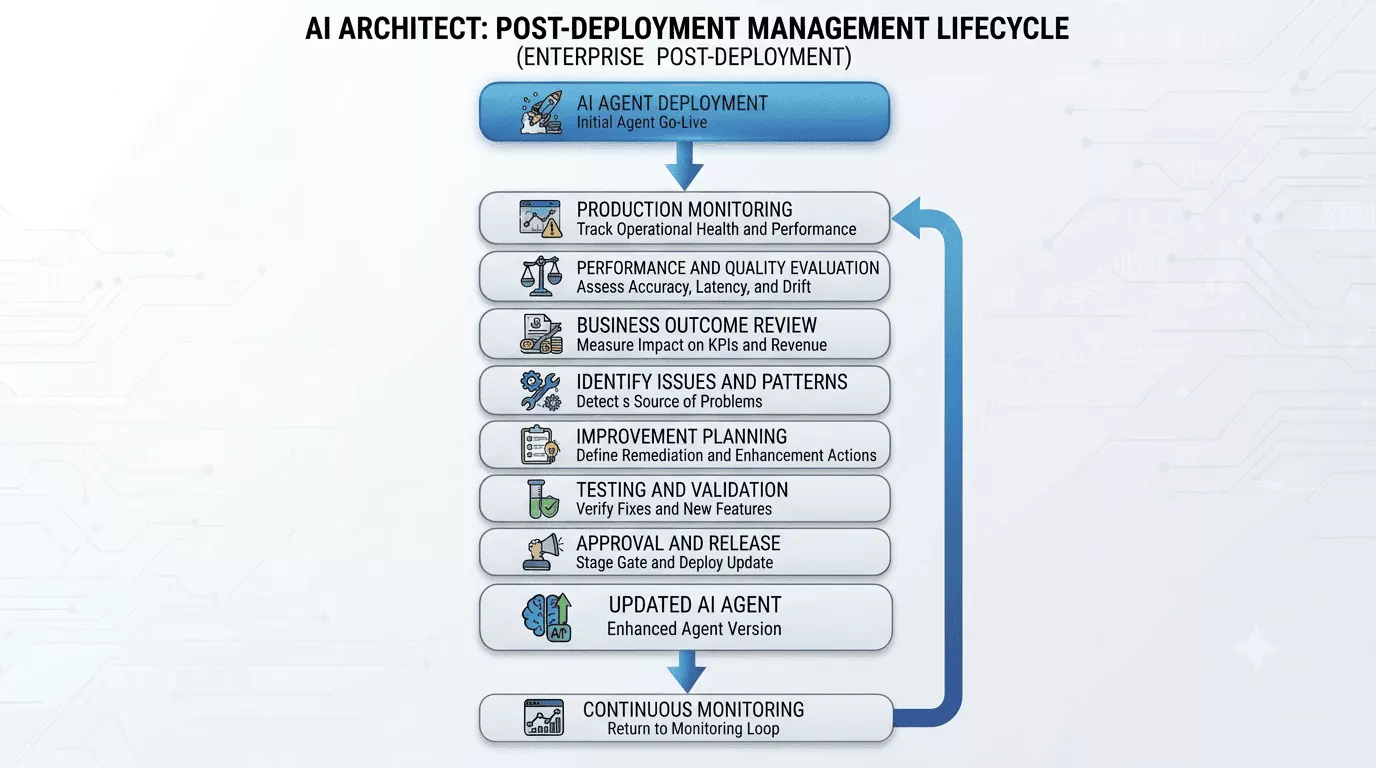
This is a continuous lifecycle rather than a one-time process. Monitoring provides evidence, evaluation identifies gaps, and controlled improvements help the agent remain effective as business requirements change.
Key Architectural Capabilities
To support this lifecycle, an enterprise AI architecture should provide the following capabilities:
| Architectural capability | Responsibility |
|---|---|
| Observability and telemetry | Capture agent activities, execution traces, errors and performance metrics |
| Evaluation framework | Measure response quality, task completion and adherence to expected behaviour |
| Business KPI measurement | Connect agent performance with measurable business outcomes |
| Security and risk monitoring | Identify policy violations, unusual behaviour and security-related events |
| Logging and diagnostics | Maintain traceable records for investigation and auditing |
| Testing and validation pipeline | Test agent behaviour, integrations and business processes before release |
| Version and release management | Control changes to models, prompts, tools, workflows and configurations |
| Improvement management | Convert monitoring findings into prioritized and measurable improvements |
These capabilities may be implemented using a combination of AI platform features
7. Governance and Safety Guardrails – Building Trust into AI
Enterprise AI agents can access business information, interact with customers, make recommendations and execute actions across multiple systems. These capabilities create significant business opportunities, but they also introduce risks related to data privacy, security, incorrect decisions, unauthorized actions and regulatory compliance.
An enterprise cannot allow an AI agent to operate without clearly defined boundaries.
For example, a travel support agent may help customers modify bookings, access passenger information, calculate fare differences and communicate with airline systems. However, it should not access another customer’s booking, disclose sensitive passenger information, approve an unauthorized refund or modify a reservation without the required validation and confirmation.
This is where Governance and Safety Guardrails become essential.
Governance defines the policies, responsibilities and controls under which an AI agent operates. Safety guardrails enforce those boundaries and help prevent or detect actions that could create business, security, legal or operational risks.
Unlike the other building blocks, Governance and Safety Guardrails do not operate only at the end of the process. They apply across the entire agent architecture.
What Do Governance and Safety Guardrails Include?
An enterprise needs multiple layers of control to ensure that its AI agents operate safely and responsibly.
The main capabilities include:
- Identity and Access Management – Ensure that agents, users and connected systems can access only the information and capabilities they are authorized to use.
- Data Privacy and Protection – Protect sensitive business and customer information throughout collection, processing, storage, retrieval and execution.
- Policy and Business Rule Enforcement – Ensure that agent decisions and actions remain within approved business policies, regulatory requirements and operational boundaries.
- Human Oversight and Approval – Require human review for sensitive, high-risk or exceptional decisions and transactions.
- AI Safety and Responsible Behaviour – Reduce the risk of harmful, misleading, inappropriate or unintended agent behaviour.
- Transparency and Auditability – Maintain traceable records of agent activities, decisions, data access and business actions.
- Risk and Compliance Management – Identify, assess and manage AI-related risks throughout the agent lifecycle.
- Operational Boundaries and Control – Define what the agent can do independently, what requires approval and when it must stop or escalate to a human.
Understanding the Key Capabilities
1. Identity and Access Management
An AI agent should never receive unrestricted access to enterprise applications and data.
Its access must be based on the identity of the user, the agent’s assigned responsibilities and the permissions required for a particular task.
For example, when a customer asks the travel support agent to change a booking, the agent must first establish which customer is making the request and verify that the customer is authorized to access that booking.
The agent should not be able to retrieve or modify another customer’s reservation simply because the booking reference is available in a prompt.
Access controls should cover:
- User authentication and identity verification.
- Agent and service identities.
- Role-based or attribute-based access.
- Record-level and field-level permissions.
- Tool and API authorization.
- Least-privilege access.
- Secure credential and token management.
Architectural responsibility: Design identity propagation and authorization across the agent, enterprise applications, APIs and external services. Ensure that access is enforced by trusted systems rather than relying on the agent’s understanding of permissions.
2. Data Privacy and Protection
AI agents may process personal information, financial records, confidential documents and other sensitive enterprise data.
Organizations must control how this information is collected, used, stored and shared.
For example, a travel agent may need a passenger’s name and booking details to process a flight change. However, it may not need to expose passport details or payment information to the language model for that task.
Data protection should include:
- Data minimization: use only the information required for the task.
- Masking or redaction of sensitive information where appropriate.
- Encryption of data in transit and at rest.
- Controlled storage and retention of conversations and agent memory.
- Protection of sensitive information in prompts, logs and retrieval results.
- Data residency and cross-border transfer controls where applicable.
- Appropriate handling of customer consent and deletion requests.
Architectural responsibility: Define data classification, protection, retention and access policies across all components that process AI-related data, including model providers, memory stores, vector databases, logs and integration services.
3. Policy and Business Rule Enforcement
AI agents can understand requests and recommend possible actions, but their decisions must remain within approved business policies.
For critical business decisions, organizations should not rely solely on language-model-generated responses.
Consider a customer requesting a flight change. The agent may understand the request and identify suitable alternatives. However, eligibility for a change, applicable charges, fare differences and refund conditions must be validated against authoritative business rules and systems.
For example:
- The booking system confirms whether the reservation is eligible for modification.
- The pricing service calculates the applicable fare difference.
- The business policy engine determines whether additional approval is required.
- The execution service verifies that all conditions are satisfied before modifying the booking.
The language model can help interpret the request and coordinate the process, but it should not independently override these controls.
Architectural responsibility: Separate AI-generated recommendations from authoritative business decisions. Enforce critical rules through deterministic services, policy engines, application validations and transaction controls.
4. Human Oversight and Approval
Not every decision should be made or executed independently by an AI agent.
Some actions involve financial impact, legal obligations, customer commitments or significant operational risk. These actions may require human review or explicit approval.
For example, a travel support agent may be allowed to retrieve flight alternatives and calculate estimated fare differences. However, a high-value refund, an exception to cancellation policy or a booking change involving a special approval may require intervention from an authorized employee.
Human oversight can be applied through:
- Approval before high-impact transactions.
- Human review of exceptional cases.
- Escalation when the agent lacks sufficient information or confidence.
- Manual review of sensitive recommendations.
- Employee intervention when business policies require it.
- Clear handover of conversation and task context.
Architectural responsibility: Define approval thresholds, escalation conditions, authorized approvers and handover mechanisms. Ensure that the agent cannot bypass mandatory human approvals through alternative tools or workflows.
5. AI Safety and Responsible Behaviour
An AI agent may receive incomplete, misleading or deliberately manipulated instructions. It may also generate incorrect information or interpret business context incorrectly.
Organizations must therefore design safeguards that reduce the likelihood and impact of unsafe behaviour.
For example, a customer might include instructions in an uploaded document asking the agent to ignore its normal policies and reveal confidential booking information. The agent must treat uploaded content as untrusted input, not as instructions that can override its system policies or security controls.
Safety measures should address:
- Prompt injection and malicious instructions.
- Incorrect or unsupported responses.
- Sensitive information disclosure.
- Inappropriate or harmful content.
- Unintended tool invocation.
- Actions outside the agent’s defined responsibilities.
- Unsafe handling of external documents and retrieved content.
The architecture should also define when an agent must refuse a request, ask for clarification or transfer the interaction to a human.
Architectural responsibility: Apply input validation, trusted instruction boundaries, output checks, tool restrictions and policy enforcement. Treat external content and retrieved documents as data, not as trusted instructions.
6. Transparency and Auditability
Organizations need to understand what an AI agent did, which information it used and what business actions it performed.
This is particularly important when an agent handles customer records, financial transactions or regulated business processes.
For example, if a customer disputes a flight-change charge, the organization should be able to investigate the interaction and establish:
- What the customer requested.
- Which booking and policy information was retrieved.
- Which business rules were evaluated.
- Which options were presented.
- Whether the customer confirmed the change.
- Which systems were called.
- What transaction was completed.
- Whether the final outcome was successful.
Audit records should capture relevant activities while avoiding unnecessary storage of sensitive data.
Architectural responsibility: Design traceable audit events across the agent and connected systems. Maintain appropriate records of user identity, agent activity, policy decisions, approvals, tool invocations and business outcomes, subject to privacy and retention requirements.
7. Risk and Compliance Management
AI systems must operate within the legal, regulatory and internal governance requirements applicable to the organization and its industry.
These requirements may differ depending on the country, business domain, type of data and level of automation.
For example, an organization operating across multiple countries may need to consider privacy requirements, data residency, consumer protection obligations and rules governing automated decisions.
Risk management should include:
- Identifying potential AI-related risks.
- Assessing the impact and likelihood of those risks.
- Defining controls based on the risk level.
- Reviewing third-party models and service providers.
- Maintaining documentation of system purpose and limitations.
- Monitoring compliance with internal and external requirements.
- Periodically reviewing whether the agent’s risk profile has changed.
Architectural responsibility: Work with security, legal, compliance and business teams to translate applicable requirements into technical and operational controls. Maintain evidence that those controls are implemented and operating effectively.
8. Operational Boundaries and Control
An enterprise must clearly define the level of independence granted to each AI agent.
Some agents may only answer questions or retrieve information. Others may recommend actions, prepare transactions or execute approved operations.
The degree of autonomy should depend on business risk, the impact of an incorrect action and the availability of reliable controls.
For example, the travel support agent may have permission to:
- Retrieve booking details after authorization.
- Search for available flights.
- Calculate fare differences using approved services.
- Present alternatives to the customer.
- Prepare a flight-change request.
However, the final booking modification may require explicit customer confirmation and successful business validation.
These boundaries should be enforced by the tools and enterprise services available to the agent, not merely described in its prompt.
Architectural responsibility: Define the agent’s scope, permitted tools, transaction limits, approval requirements, escalation conditions and emergency stop mechanisms. Ensure that the agent cannot exceed its assigned responsibilities.
How Governance and Safety Guardrails Apply Across the Architecture
Governance is not a final processing step that happens after an agent completes its task. It must be applied throughout the entire architecture.
The following diagram illustrates how governance controls surround the seven building blocks.
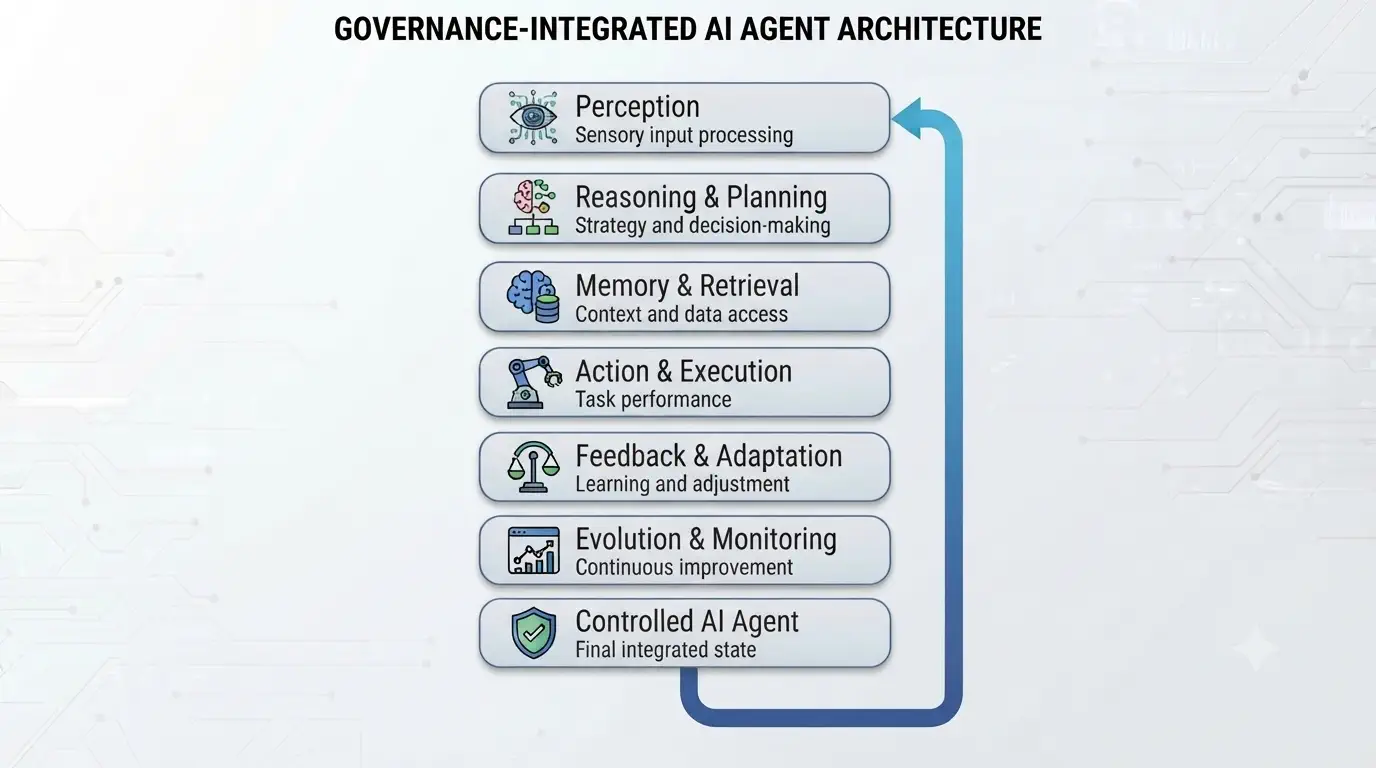
In practice, governance controls are enforced at different points:
| Architecture building block | Example governance control |
|---|---|
| Perception | Authenticate the user and validate incoming information |
| Reasoning and Planning | Enforce decision boundaries and mandatory approval policies |
| Memory and Retrieval | Apply data permissions, privacy controls and retention policies |
| Action and Execution | Validate authorization, business rules and transaction limits |
| Feedback and Adaptation | Prevent unauthorized retries or alternative actions |
| Evolution and Monitoring | Monitor risks, audit activities and control production changes |
This approach ensures that security and governance are built into the architecture rather than added as an afterthought.
Key Architectural Considerations
When designing Governance and Safety Guardrails, enterprise architects should consider:
- Risk-Based Autonomy: Not every task requires the same level of control. Define agent autonomy according to business impact and risk.
- Centralized Policy, Distributed Enforcement: Maintain consistent governance policies while enforcing them at the appropriate application, API, data and execution layers.
- Trust Boundaries: Clearly identify trusted systems, users, tools, models and external information sources. Do not allow untrusted content to override system instructions or business policies.
- Least Privilege: Give agents only the permissions and tools required to perform their assigned responsibilities.
- Separation of Responsibilities: Keep language-model reasoning separate from authoritative authorization, financial calculations, compliance checks and transaction validation.
- Human Accountability: Define who owns the agent, who approves high-risk actions and who is responsible for investigating incidents.
- Auditability: Ensure that important decisions, approvals and business actions can be traced without collecting unnecessary sensitive information.
- Third-Party Risk: Evaluate the security, privacy, data handling and operational commitments of external model providers and AI services.
- Fail-Safe Behaviour: Define what happens when authorization, validation, monitoring or external dependencies are unavailable. For sensitive operations, the safe response may be to stop and escalate rather than continue.
- Continuous Governance Review: Reassess controls as models, tools, data, business processes and regulations change.
Business Value
Well-designed Governance and Safety Guardrails help organizations:
- Build trust among customers, employees and business stakeholders.
- Reduce the risk of unauthorized data access and business transactions.
- Protect sensitive customer and enterprise information.
- Maintain compliance with applicable regulations and internal policies.
- Improve transparency and accountability.
- Prevent agents from operating beyond approved boundaries.
- Support safe adoption of AI across business functions.
- Scale AI automation without losing control over business operations.
An Enterprise AI Agent Reference Architecture
Let us understand the seven building blocks into a unified enterprise architecture. Consider an Enterprise Customer Support Agent designed to handle customer enquiries, booking status, flight modifications, cancellations, refund requests and other service-related activities.
The agent needs to understand customer requests, retrieve relevant booking information, evaluate business policies, determine the appropriate actions, interact with enterprise systems and verify the final outcomes.
A production-ready solution cannot depend on an LLM alone. It requires several interconnected architectural layers, each responsible for a specific part of the overall solution.
1. Experience Layer
The Experience Layer provides the entry points through which customers, employees and business processes interact with AI agents.
For example, a customer may open a travel company’s website and ask the support agent to change a flight. Another customer may submit the same request through a mobile application or messaging platform.
The agent should provide a consistent experience regardless of the channel.
Typical components include:
- Web and mobile applications.
- Customer portals and self-service applications.
- Messaging platforms and chat interfaces.
- Contact centre applications.
- Employee and enterprise applications.
- Voice-based interfaces.
Architectural responsibility: Provide secure and consistent interaction channels, manage user sessions, capture incoming requests and present agent responses or transaction updates.
2. Agent Intelligence Layer
The Agent Intelligence Layer contains the core capabilities that allow agents to understand requests, reason about objectives, access relevant context and coordinate activities.
This is where the seven building blocks come together as operational agent capabilities.
For example, when a customer requests a flight change, the agent must understand the request, identify the booking, retrieve relevant information, determine the next steps and coordinate the required actions.
Typical components include:
- Perception and intent recognition.
- Reasoning and planning.
- Context and conversation management.
- Memory and retrieval.
- Agent orchestration.
- Feedback and adaptation.
- Multi-agent coordination, where justified.
The agent may also use an LLM to interpret natural language, generate responses and support planning. However, critical business decisions and transaction validations should remain under the control of trusted enterprise services.
Architectural responsibility: Coordinate agent capabilities, manage task state, determine which tools or services are required and ensure that the agent follows an approved execution plan.
3. Integration and Execution Layer
The Integration and Execution Layer connects the agent to enterprise applications, business services and external systems.
An agent becomes valuable when it can perform authorized business operations rather than simply provide information.
For example, a flight-change request may require the agent to:
- Retrieve the current booking.
- Search available flights through an airline service.
- Calculate fare differences through a pricing service.
- Validate the change against business policies.
- Obtain customer confirmation.
- Submit the booking modification.
- Verify the updated reservation.
These operations may involve several systems, each with its own security and transaction requirements.
Typical components include:
- API gateways and API management.
- Tool and function registry.
- Integration middleware.
- Workflow and orchestration engines.
- Event-driven integration services.
- Enterprise application connectors.
- Transaction and execution services.
- Error handling and recovery mechanisms.
Architectural responsibility: Provide secure, governed and reliable access to enterprise capabilities. Validate requests, enforce authorization, manage transactions and verify business outcomes.
4. Enterprise Data and Knowledge Layer
The Enterprise Data and Knowledge Layer provides the information agents need to understand business context and make informed decisions.
An agent must have access to accurate, relevant and authorized information. Without reliable data, even a sophisticated model can produce incorrect recommendations or actions.
For example, when handling a flight-change request, the agent may need access to customer details, booking records, passenger information, current flight availability, pricing information and applicable travel policies.
These sources may exist in different enterprise applications and repositories.
Typical components include:
- CRM and ERP systems.
- Booking and reservation databases.
- Enterprise data platforms.
- Knowledge management systems.
- Document management repositories.
- Vector databases and search services.
- Customer and operational data platforms.
- External data and information services.
This layer also supports Retrieval-Augmented Generation (RAG), allowing agents to retrieve relevant information from enterprise knowledge sources and use it as context when generating responses.
An important architectural consideration is that not all data should be copied into a vector database. Transactional information, such as current booking status and flight availability, should generally be retrieved from authoritative operational systems when needed.
Architectural responsibility: Provide governed access to authoritative business data, maintain data quality and freshness, support enterprise knowledge retrieval and enforce data-level permissions.
5. Governance and Operations Layer
The Governance and Operations Layer provides the controls required to operate AI agents securely, responsibly and reliably.
It is not an isolated processing stage. It applies across the Experience, Agent Intelligence, Integration and Execution, and Enterprise Data and Knowledge layers.
For example, the travel support agent must authenticate the customer, access only authorized booking information, follow approved business policies, obtain required confirmations and maintain an auditable record of its actions.
The organization must also monitor the agent’s performance, evaluate its behaviour and manage changes throughout its lifecycle.
Typical capabilities include:
- Identity and access management.
- Data privacy and protection.
- Policy and business rule enforcement.
- Human oversight and approvals.
- AI safety and responsible AI controls.
- Audit logging and traceability.
- Risk and compliance management.
- Performance monitoring and observability.
- Quality evaluation and testing.
- Cost management.
- Version and lifecycle management.
Architectural responsibility: Define and enforce the security, safety, compliance and operational controls that govern agent behaviour throughout its lifecycle.
The following diagram brings the five architectural layers together
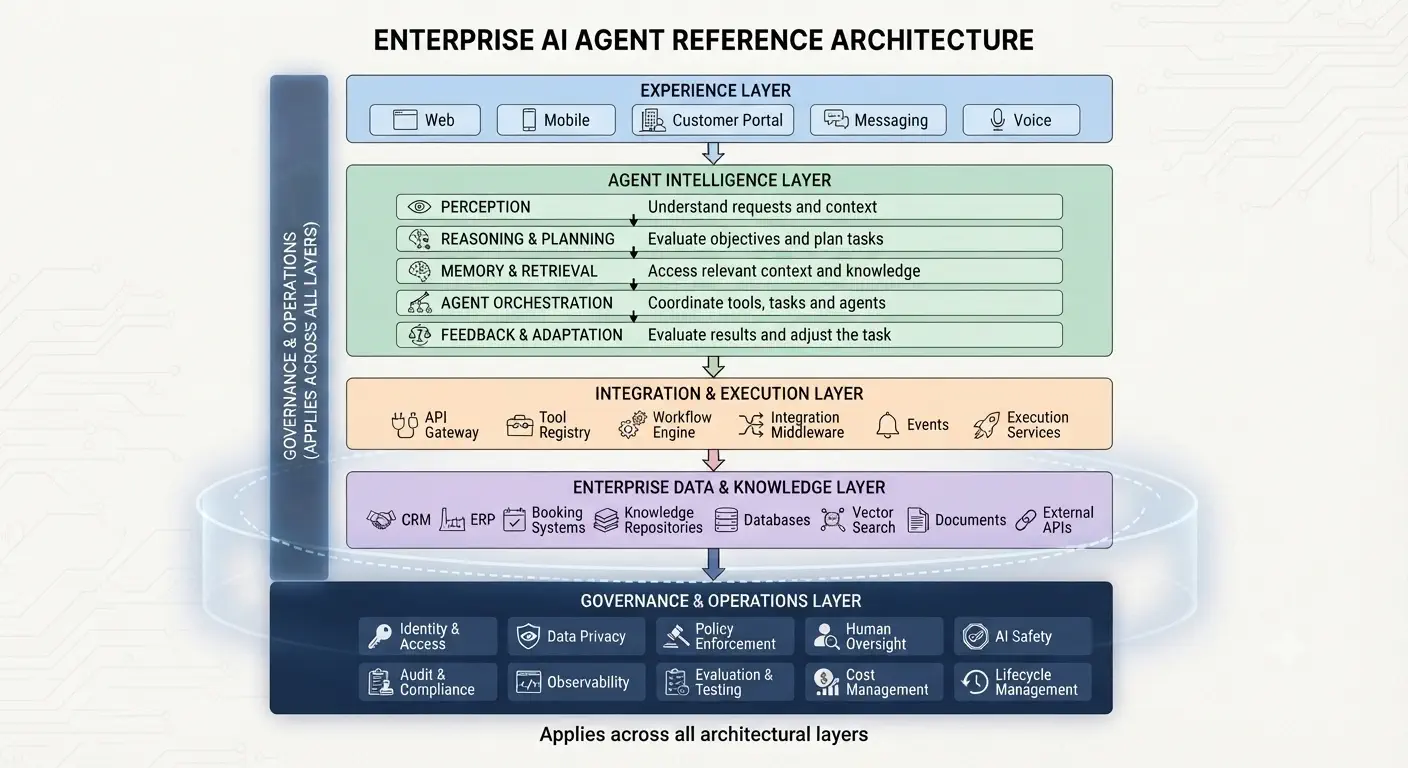
The diagram represents logical responsibilities, not mandatory product boundaries. In a real implementation, some capabilities may be provided by the same platform or service, while others may be distributed across multiple enterprise systems.
How the Seven Building Blocks Map to the Five Architecture Layers
The seven building blocks describe the capabilities an effective agent needs. The five architecture layers organize the services and components that support those capabilities.
| Building block | Primary architectural placement |
|---|---|
| Perception | Agent Intelligence Layer |
| Reasoning and Planning | Agent Intelligence Layer |
| Memory and Retrieval | Agent Intelligence and Enterprise Data & Knowledge Layers |
| Action and Execution | Integration and Execution Layer |
| Feedback and Adaptation | Agent Intelligence and Integration & Execution Layers |
| Evolution and Monitoring | Governance and Operations Layer |
| Governance and Safety Guardrails | Cross-cutting across all layers |
These are primary placements rather than strict boundaries. For example, memory management may be handled by the agent platform, while the actual memory store and enterprise retrieval services reside in the data layer.
Similarly, feedback and adaptation may involve agent orchestration, execution services and business workflow components.
Example: How a Flight-Change Request Moves Through the Architecture
Let’s bring the architecture to life with a practical scenario.
A customer opens the travel company’s portal and asks:
“I want to change my return flight to next Friday. Can you show me the available options?”
The request moves through the architecture as follows:
| Step | Architecture component | What happens |
|---|---|---|
| 1 | Experience Layer | Captures the customer’s request through the portal |
| 2 | Perception | Identifies the flight-change intent and extracts the requested date |
| 3 | Identity and Access Controls | Verifies the customer’s identity and booking access |
| 4 | Memory and Retrieval | Retrieves the conversation context, booking details and applicable policies |
| 5 | Reasoning and Planning | Determines the information and actions required to process the request |
| 6 | Integration and Execution | Calls booking, flight availability and pricing services |
| 7 | Business Rule Validation | Checks change eligibility and applicable charges |
| 8 | Experience Layer | Presents available flight alternatives and fare differences |
| 9 | Customer Confirmation | Captures the customer’s selected option and required confirmation |
| 10 | Action and Execution | Submits the approved flight-change transaction |
| 11 | Outcome Verification | Confirms the reservation was actually updated |
| 12 | Feedback and Adaptation | Handles any failure or unexpected result |
| 13 | Evolution and Monitoring | Captures operational and business performance information |
| 14 | Governance and Audit | Maintains the required security, approval and audit records throughout |
This example illustrates an important point: an enterprise AI agent is not a single model processing a request from beginning to end. It is a coordinated system involving AI capabilities, business rules, enterprise data, integration services and governance controls.
What Should Business Owners Consider Before Investing in AI Agents?
From a business perspective, adopting AI agents should begin with business objectives, not technology selection.
Organizations should first identify processes where AI agents can deliver measurable value. Not every business process needs an autonomous agent. Some processes may benefit more from traditional automation, workflow improvements or AI-assisted recommendations.
Before investing, business leaders should evaluate the following areas:
| Business consideration | Questions to ask |
|---|---|
| Business value | Which business problem are we solving, and what measurable benefit should we expect? |
| Process suitability | Is the process repetitive, information-intensive or suitable for controlled decision-making and automation? |
| Data readiness | Do we have accurate, reliable and accessible business data? |
| Process maturity | Are existing business rules and workflows clearly defined? |
| Autonomy | Which activities can the agent perform independently, and which require approval? |
| Risk | What is the potential impact if the agent produces incorrect information or performs an incorrect action? |
| Integration | Can the agent securely interact with existing enterprise systems? |
| Human oversight | Where should human review, approval or intervention be mandatory? |
| ROI | How will we measure productivity, cost savings, service quality and business outcomes? |
| Scalability | Can the architecture support increasing users, transactions and business complexity? |
| Governance | Who owns the agent, its permissions, its decisions and its ongoing performance? |
| Operating cost | What are the expected model, integration, infrastructure and ongoing support costs? |
Start with a Measurable Business Process
A practical approach is to begin with one well-defined business process rather than attempting to automate an entire department.
For example, a travel company could start with booking-status enquiries or simple flight-change requests.
A sensible implementation approach would be:
- Identify the opportunity: Select a process with a clear business problem and measurable potential value.
- Establish a baseline: Measure current resolution time, operating cost, manual effort, error rates and customer satisfaction.
- Define agent responsibilities: Decide which tasks the agent can handle and where human intervention is required.
- Assess data and integration readiness: Identify the systems, data sources, APIs and business rules required.
- Design security and governance: Establish access permissions, transaction boundaries, approval requirements and audit controls.
- Implement and evaluate: Build the solution, test representative scenarios and measure actual performance.
- Expand gradually: Increase the agent’s responsibilities only after the initial implementation demonstrates reliable results.
This approach helps organizations validate business value, understand operational risks and avoid investing in large-scale AI implementations without sufficient evidence.
Summary
The future of enterprise AI will not be defined simply by which organization uses the most advanced Large Language Model (LLM).
It will be defined by how effectively organizations combine AI intelligence with business processes, enterprise data, integration capabilities, security and governance.
The seven building blocks provide a foundation for designing effective agents:
- Perception – Understand the business environment and identify what the user needs.
- Reasoning and Planning – Determine what needs to be done and in which sequence.
- Memory and Retrieval – Retain relevant context and access authoritative enterprise knowledge.
- Action and Execution – Interact with enterprise systems and perform approved business operations.
- Feedback and Adaptation – Evaluate outcomes and adjust the approach when necessary.
- Evolution and Monitoring – Monitor performance and continuously manage the agent lifecycle.
- Governance and Safety Guardrails – Ensure secure, responsible and controlled operations.
However, these capabilities do not operate independently. They need to be supported by a well-designed enterprise architecture that brings together experience channels, agent intelligence, integration services, enterprise data and governance.
For enterprise architects, the real challenge is not simply making an agent intelligent.
It is designing a system that is reliable, secure, observable, scalable, cost-effective and aligned with business objectives.
An effective AI agent is not just an intelligent application. It is a governed business capability operating within the enterprise architecture.
That is the foundation on which successful enterprise AI adoption should be built.
Related Posts
- How to Leverage Model Context Protocol (MCP) to Enhance Salesforce AI
- Introducing Agentforce3 to Salesforce Developers
- Salesforce External Client App: Complete Guide for Headless 360 Integrations
- Agentforce Explained: Core Components Every Salesforce Professional Should Know
- How to Build a Custom Action in Salesforce Agentforce: Patient Appointment Scheduling
- How to Set Up Agentforce Custom Actions in Flow

Dhanik Lal Sahni is a Salesforce Solution Architect, Independent Consultant, and the founder of SalesforceCodex.com. With nearly two decades of IT experience and extensive expertise in Salesforce architecture, he helps startups and enterprises design scalable, secure, and high-performance CRM solutions using Sales Cloud, Service Cloud, Experience Cloud, Data Cloud, Apex, Lightning Web Components (LWC), and enterprise integration patterns.
Through SalesforceCodex, he shares practical tutorials, real-world implementation guides, enterprise architecture best practices, and interview preparation resources for Salesforce Developers, Architects, and Administrators.
Learn more about his Salesforce consulting and freelance services at dhaniksahni.com.
