

The Dependency Inversion Principle (DIP) is one of the most valuable SOLID principles for building scalable and maintainable Salesforce applications. If you’ve ever made a small change to a class that impacted triggers, batch jobs, or unit tests and suddenly started failing, you’ve experienced the problems caused by tightly coupled code.
In many Salesforce applications, business logic depends directly on implementation details such as SOQL queries, DML operations, or external API integrations. While this approach may work initially, it makes the code harder to test, maintain, and extend as the application grows.
The Dependency Inversion Principle solves this problem by encouraging high-level business logic to depend on abstractions rather than concrete implementations. By applying the Dependency Inversion Principle in Apex, you can create code that is more flexible, easier to test, and better prepared for future changes.
What is the Dependency Inversion Principle?
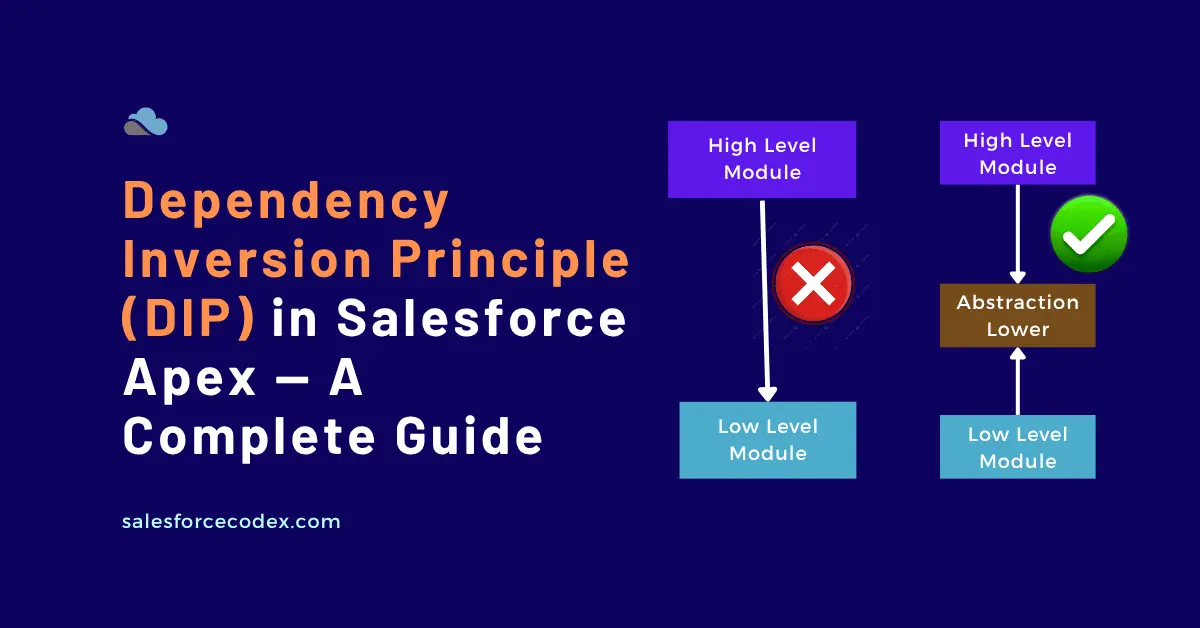
The Dependency Inversion Principle (DIP) is one of the five SOLID principles and focuses on reducing dependencies between different parts of your application. Instead of high-level business logic depending directly on low-level implementation details, both should depend on a common abstraction, typically an interface.
Robert C. Martin defines the Dependency Inversion Principle with two key rules:
- High-level modules should not depend on low-level modules. Both should depend on abstractions.
- Abstractions should not depend on details. Details should depend on abstractions.
In simpler terms, depend on interfaces, not concrete classes.
Rather than having a business service directly create and use a specific implementation, it should rely on an interface that defines the required behavior. Concrete implementations then provide the actual functionality behind that interface. This approach keeps business logic independent from implementation details and makes the system easier to change over time.
DIP Violation: Hard-Coded Dependencies
Why Is This a Problem?
Now imagine you want to write a unit test for onAccountCreated().
At first glance, testing the method seems straightforward. However, because the class directly depends on concrete services, testing quickly becomes complicated.
EmailNotificationServiceattempts to send a real email, creating unnecessary side effects during testing.ERPSyncServiceattempts to make a real HTTP callout, which results in aSystem.CalloutExceptionunless you addTest.setMock()setup code.- If the ERP integration changes in the future, you’ll need to modify
AccountServiceeven though the underlying business process remains exactly the same.
These are clear signs of tight coupling. The business logic is directly tied to infrastructure concerns such as email delivery and external integrations.
As a result, the class cannot be tested in isolation. To verify a simple business rule, you must also deal with email services, callout mocks, and integration dependencies. This makes tests more complex, slower to write, and harder to maintain.
Solving the Problem with the Dependency Inversion Principle
The Dependency Inversion Principle solves this problem by removing the direct dependency on concrete implementations. Instead of working with specific classes, the business logic depends on abstractions (interfaces).
Applying the solution is straightforward:
- Create an interface for each infrastructure dependency, such as email notifications or ERP integrations.
- Update the high-level class to accept these interfaces through its constructor (constructor injection).
- Provide the real implementations in production and mock implementations during testing.
With this approach, the business logic no longer cares how an email is sent or how an ERP system is updated. It only relies on the contract defined by the interface. This makes the code easier to test, maintain, and extend while keeping infrastructure concerns separate from business rules.
The AccountService class doesn’t need to know whether it is working with a real email service, a mock implementation, or even a completely different notification provider. It interacts only with the contracts defined by IEmailNotificationService and IERPSyncService.
This separation is the core idea behind the Dependency Inversion Principle. The business logic focuses on what needs to happen, while the concrete implementations handle how it happens. As a result, the code becomes easier to test, more flexible to change, and less dependent on specific technologies or integrations.
Why the Dependency Inversion Principle Matters in Apex
The Dependency Inversion Principle is especially valuable in Salesforce Apex, where applications often interact with databases, external services, and platform-specific features. When business logic directly depends on these components, code becomes difficult to test, maintain, and extend.
Applying the Dependency Inversion Principle in Apex provides several important benefits:
True Unit Testing
By separating business logic from database operations and external dependencies, you can test your code using mocks, stubs, or Apex Enterprise Patterns (FFLIB) without creating actual records. This leads to faster, more focused, and more reliable tests.
Easier Refactoring
Requirements change constantly. You may need to replace one payment provider with another, migrate from a legacy integration to a modern API, or change how data is stored. When your code follows the Dependency Inversion Principle, these changes can often be made by swapping implementations while leaving the core business logic untouched.
Better Team Collaboration
Different developers can work independently on separate parts of the system. One developer can build business logic against an interface while another develops the concrete implementation. As long as both follow the same contract, their work can be integrated smoothly.
Greater Flexibility and Maintainability
Because high-level components are not tied to specific implementations, your application becomes easier to extend and adapt. New features can often be added by introducing new implementations rather than modifying existing business logic, reducing the risk of regressions and making the codebase easier to maintain.
Drawbacks of the Dependency Inversion Principle
Like every design principle, the Dependency Inversion Principle should be applied thoughtfully. While it provides significant benefits for testability and flexibility, it also introduces additional complexity.
1. More Code for Simple Scenarios
Applying DIP often requires creating interfaces and adding constructor injection. For complex services, this is usually worthwhile. However, for a simple class with a single dependency that is unlikely to change or require mocking, the extra code may provide little value.
The level of abstraction should match the complexity of the problem being solved.
2. Overusing Dependency Injection
A common mistake is injecting every possible dependency into a class. Before long, constructors become difficult to read and maintain because they require numerous parameters.
Not every dependency needs an interface. Focus on infrastructure boundaries such as email services, external APIs, file storage, and third-party systems. Simple helper methods and utility functions rarely benefit from dependency injection.
3. Service Locator Can Introduce Global State
When using the Service Locator pattern, dependencies are often stored in static variables. If a test replaces a dependency with a mock and fails to restore the original implementation, other tests may behave unexpectedly.
To avoid this issue, always reset mocked dependencies during test setup or restore them using a try/finally block.
When Should You Apply the Dependency Inversion Principle?
The Dependency Inversion Principle delivers the most value when your code interacts with external infrastructure or when testability is important.
Apply DIP when:
- A class sends emails, performs callouts, publishes events, or interacts with external systems.
- You want business logic to be tested independently of infrastructure concerns.
- The underlying implementation may change in the future, such as switching email providers or integrating with a different ERP system.
- Multiple classes share the same infrastructure service and need a simple way to swap in mock implementations during testing.
- You are building reusable services, frameworks, or shared libraries that other developers will extend or integrate with.
When Should You Avoid the Dependency Inversion Principle?
Not every class needs an interface.
Avoid DIP when:
- The class contains only utility logic, such as string manipulation, date calculations, or formatting functions.
- The dependency is already testable using Salesforce’s built-in testing features.
- You are writing a one-time script or temporary migration code that won’t be maintained long term.
- The dependency is simply a configuration value. In these cases, use Custom Metadata Types, Custom Settings, or Custom Labels instead of dependency injection.
Summary
The Dependency Inversion Principle is one of the most effective ways to build maintainable and testable Apex applications. By making business logic depend on interfaces instead of concrete implementations, you separate your core application behavior from infrastructure concerns.
In practice, applying the Dependency Inversion Principle comes down to two simple rules:
- Define interfaces for infrastructure dependencies such as email services, callouts, and external integrations.
- Inject those dependencies through constructors or a Service Locator rather than creating them directly with
newinside business logic.
The result is a codebase that is easier to test, simpler to maintain, and more adaptable to change. As your Salesforce org grows and requirements evolve, this flexibility becomes increasingly valuable. A small investment in good architecture today can save countless hours of maintenance and refactoring in future releases.
SOLID Series — Complete Index
| Principle | Core Idea |
|---|---|
| Single Responsibility | One class, one reason to change |
| Open/Closed | Extend with new classes, never modify old ones |
| Liskov Substitution | Any implementation must fully honor its contract |
| Interface Segregation | Small, focused interfaces — no forced dead code |
| Dependency Inversion | Depend on abstractions, not concrete classes |
References
- The Art of Naming (Clean Code for Salesforce Developers)
- How to Confidently Manage Transactions in Salesforce Apex
- Top Mistakes Developers Make in Salesforce Apex Triggers
- How to Handle Bulkification in Apex with Real-World Use Cases
- Best Practices to Avoid Hardcoding in Apex
Other Important Posts
- The Ultimate Guide to Apex Order of Execution for Developers
- How to Manage Technical Debt in Salesforce
- The Ultimate Checklist for Efficiently Querying Large Data Sets
- Optimizing Salesforce Apex Code
- Efficient Ways to Debug Salesforce Platform Events
- Handle Heap Size for Apex Code Optimization
- Build Scalable Solutions with Salesforce
- How to Correctly Publish Platform Event Using Salesforce Apex

Dhanik Lal Sahni is a Salesforce Solution Architect, Independent Consultant, and the founder of SalesforceCodex.com. With nearly two decades of IT experience and extensive expertise in Salesforce architecture, he helps startups and enterprises design scalable, secure, and high-performance CRM solutions using Sales Cloud, Service Cloud, Experience Cloud, Data Cloud, Apex, Lightning Web Components (LWC), and enterprise integration patterns.
Through SalesforceCodex, he shares practical tutorials, real-world implementation guides, enterprise architecture best practices, and interview preparation resources for Salesforce Developers, Architects, and Administrators.
Learn more about his Salesforce consulting and freelance services at dhaniksahni.com.
